


Suzuka to Miami: What the Japanese GP Tells Us About F1's 2026 Data Gap

By Timothy D. Harmon, CISSP | Lead Enterprise Architect — Project Apex | March 2026 | #F12026 #CyberPhysicalSecurity #ProjectApex #JapaneseGP

On Lap 22 of the 2026 Japanese Grand Prix, Oliver Bearman’s Haas approached Spoon Curve. Franco Colapinto’s Alpine was ahead. Both drivers were at full throttle. But Colapinto’s car was in energy harvesting mode — and Bearman’s was not. The closing speed differential between two cars traveling in the same direction, both drivers with their feet on the accelerator, was 50 kilometers per hour. Bearman had no warning. He moved to avoid rear-ending Colapinto, hit the grass, became a passenger, and struck the barrier at 50G.
He walked away with a bruised knee.
Bearman described it precisely: “It was a massive overspeed, 50kph, which is a real part of these new regulations that I guess we have to get used to.” The FIA issued an official statement that same night, acknowledging that “high closing speeds” contributed to the accident and confirming that meetings are scheduled in April to assess the energy management regulations. Within hours, Oscar Piastri said what no team principal had yet been willing to say openly:
“We’ve spoken about that being a possibility since these cars were conceptualised. Yeah, it’s what we’re stuck with, with the power units. There’s no easy way of getting around it.”
This article is about that gap — between what these cars do and what anyone can see them doing in real time. It is not just a racing problem. It is a data integrity problem. And Suzuka proved it, live, in front of the world, at Spoon Curve.
The Qualifying Snapshot: Headlines vs. the Buried Story

Kimi Antonelli took pole at Suzuka — the youngest driver ever to achieve back-to-back poles in Formula 1. George Russell locked out the front row for Mercedes. Oscar Piastri qualified P3 for McLaren, the team’s best qualifying result of 2026.
That is the headline story. Here is what it conceals.
Mercedes’ two-car qualifying average was +0.149 seconds from pole. McLaren’s was +0.493 seconds. The team-average gap between the two was 0.344 seconds — larger than Piastri’s individual gap. Lando Norris, who started P5, lost most of FP3 to an ERS pack issue that required a full component replacement before qualifying. His deficit to Piastri in Q3 suggests that the repair, while necessary, left him at a disadvantage in terms of preparation time.
The FIA had attempted a preemptive intervention: reducing the maximum qualifying recharge limit from 9.0 MJ to 8.0 MJ with unanimous approval from all five power unit manufacturers and all eleven teams. The stated goal was to reduce “super-clipping” — where cars harvest energy through high-speed corners, causing dramatic speed reductions — and lift-and-coast driving on flying laps.
It was not enough. Fernando Alonso, qualifying 21st in his Aston Martin, put it plainly:
“It’s gone. High-speed corners have now become the car’s charging station. So you go slow there, you charge the battery at high speed, and then you have the full power on the straight. So driver skill is not really needed anymore.”
Charles Leclerc said over team radio: “I honestly can’t stand these new rules in qualifying. I go faster in corners, I go on throttle earlier — I’m losing everything on the straight.” Carlos Sainz described the paradox at its most concrete: “I went quicker in every corner, slower in every straight, and I went 0.1 seconds slower.”
Strip the emotion from each statement, and the technical diagnosis is the same in all three cases: physical input and vehicle output have become decoupled. More driver effort produces a worse result. The feedback loop that has defined elite motorsport for a century — push harder, go faster — has broken down at precisely the circuits where driver skill has historically mattered most.

The Machine Learning Layer Nobody Is Talking About
Motorsport.com’s technical analysis of the Suzuka weekend confirmed something that has not received the attention it deserves: the power unit’s deployment software uses machine-learning algorithms that update based on previous-lap data — operating beyond the driver’s direct control.
Lewis Hamilton, who qualified P6 for Ferrari, made this concrete with one of the most technically significant quotes of the season:
“My first lap [in Q3], I was up, but I lost two-and-a-half tenths on the back straight through deployment after a snap of oversteer, and it changed the whole algorithm.”
A single unplanned physical event — one snap of oversteer — propagated into the power unit’s machine learning model and altered its deployment behavior for subsequent laps. Hamilton lost 2.5 tenths per lap as a consequence — not from the snap itself, but from the model updating on corrupted input data. The driver and team had no real-time visibility into the model’s state change. The downstream effect was invisible until it showed up as an unexplained loss of lap time.
For those outside motorsport: consider a system where a single environmental anomaly causes a self-modifying algorithm to update its operating parameters — and where the human operator has no independent reference to determine whether the update was valid or whether the model is now running on bad data. The system is not malfunctioning. It is learning. But it is learning from corrupted input, with no ground-truth layer to validate the output.
That is the 2026 F1 power unit in qualifying trim. It runs in every car, at every circuit, every weekend.
The Race: When Decoupling Becomes Dangerous

The race began with Antonelli making another poor start — the third consecutive race where Mercedes lost the lead from pole position. The 2026 regulations removed the MGU-H, requiring drivers to hold high engine revs for an extended period to spool the turbo for a fast launch. Mercedes has failed this sequence three times in three races. Piastri surged from P3 to the lead before Turn 1, sweeping past both Mercedes cars. Norris moved from P5 to P3.
For 18 laps, Piastri controlled the race. He held Russell behind him throughout, deploying McLaren’s best competitive pace of the 2026 season. Pitpass team notes confirmed he was experimenting with deployment options at the chicane entry, adapting his energy strategy lap by lap against Russell’s attack.
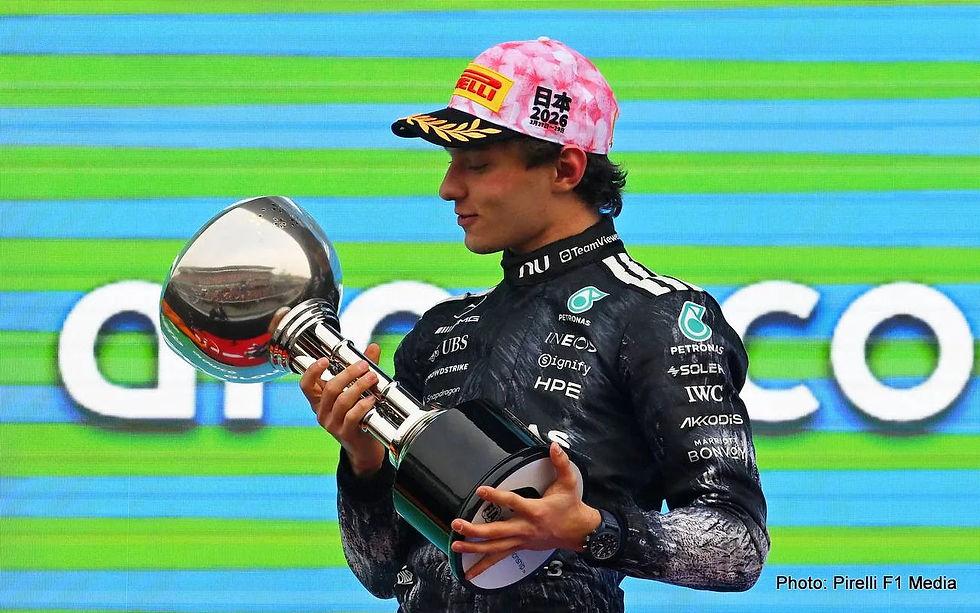
Then, on Lap 22, Bearman’s crash brought out the safety car. The timing was perfect for Antonelli, who was able to take a free pit stop and emerge with the net race lead. Post-restart, the Mercedes driver was untouchable. He won by 13.7 seconds. Piastri finished P2. Charles Leclerc completed the podium in P3 after an outside-line pass on Russell at Turn 1 that multiple outlets called the overtake of the season. Norris finished P5.
McLaren’s first race where both cars finished in 2026. Their first podium. And Piastri’s own verdict on it was this:
“We did everything right this weekend, and we still got beaten by 15 seconds. So we’ve got a pretty big gap to fill.”

The race also revealed what qualifying could not. In the post-race cooldown room, Piastri and Leclerc were comparing deployment zone maps — corner by corner, noting where each car had energy available and where it did not. Leclerc described how Russell’s team used radio communication tactically during their battle:
“They were being quite cheeky because I think his engineer was telling him things on the radio. My engineer was telling me what his engineer was saying on the radio, but he was doing the opposite — for four laps in a row, he was doing exactly the opposite.”
Deployment strategy has become an active game of deception. Teams are now broadcasting false energy state information because the car ahead’s energy mode is completely invisible to the car behind. That same invisibility — operating as a normal racing strategy between Leclerc and Russell — is what contributed to Bearman’s 50G wall impact. Piastri added important context: in his view, Colapinto was not actively super-clipping at the moment of the incident. The closing speed differential existed simply because the two cars were at different stages of energy deployment under normal racing conditions.
This is not edge-case behavior. It is the default operating state of 2026 cars in close racing.
McLaren's Reliability Arc: The Timeline Problem

Three race weekends. One consistent pattern.
Weekend |Driver | Event | Consequence
Melbourne (R1) | Piastri | Battery surge on reconnaissance lap | Crash, DNF
Shanghai (R2) | Norris | Software fault — battery bricked | DNS, unit permanently retired
Shanghai (R2) | Piastri | Hardware fault — auxiliary component | DNS, battery salvaged
Suzuka FP3 (R3) | Norris | ERS pack issue | Lost FP3, component replaced before qualifying
The instinct when reading this timeline is to conclude that McLaren has a transparency problem with their power unit supplier, Mercedes HPP. That conclusion is wrong — and McLaren’s Team Principal Andrea Stella corrected it directly at the FIA Friday press conference in Suzuka.
“It’s not like information is held back. There’s maximum sharing. We’ve been world champions together three times in the last two years, so the relationship is great. It’s more about catching up with the timeline.”
The gap is not informational. It is temporal. McLaren is a customer team that took delivery of the M17 power unit on a compressed development schedule — the same compressed timeline that affected all teams as the 2026 regulations were finalized. But unlike Mercedes, which has been simulating and developing the M17 in-house since its inception, McLaren is learning how to exploit it in production. At race speed, with no pre-season runway to close that knowledge gap before the championship began.
Stella confirmed the trajectory at Suzuka:
“This has been the smoothest Free Practice 1 in terms of power unit exploitation, which is the result of improving our learning session by session, working with HPP. The gap is pretty small compared to what is available in the power unit, and it will get smaller and smaller race after race.”
Both cars finished Suzuka — the first time in 2026. The remittances from China are held. But Norris has permanently retired one of his three-season battery allocations in just three races. A second failure before the allocation resets means a grid penalty. The margin for error has been eliminated.
The 130°C Framework: Where Physics Becomes Policy
In June 2026, the FIA will begin measuring engine compression ratios at both ambient temperature and 130°C — a change that received unanimous approval from all five power unit manufacturers. The decision followed concerns raised by Audi, Ferrari, and Honda that some manufacturers were exploiting thermal expansion to run higher effective compression ratios than the 16:1 ambient limit. Audi CEO Mattia Binotto stated that any manufacturer exploiting this differential would hold a “significant” competitive advantage.
The FIA validated the concern. The 130°C measurement protocol is the regulatory response.
Project Apex v1.1 defines THERMAL_THRESHOLD_C = 130.0 as the boundary at which the validator applies reduced vertical energy limits and begins monitoring for the convergence of thermal stress, aerodynamic squat, and torque anomalies that define a RED alert event. Suzuka is the circuit where thermal exceedances are most persistent — the Esses, 130R, and Spoon generate sustained high-speed cornering loads that keep engine temperatures elevated across consecutive laps. McLaren’s decision to shorten their heat exchangers, identified independently by designer Conor Kenny in his CK-26 specification analysis, further compresses that thermal margin. Less cooling surface area means faster temperature rise under sustained load — and a narrower window between normal operation and the threshold the FIA now formally recognizes as the measurement boundary.
The governing body codified 130°C as the regulatory standard because it is the point at which competitive advantage and physical risk converge. Every energy-related failure McLaren has experienced in 2026 — Melbourne battery surge, Shanghai software fault, Shanghai hardware fault, Suzuka ERS anomaly — falls within the thermal-electrical domain monitored by this threshold.

The ADUO Clock: Why Miami Is the Deadline
The original 2026 regulatory calendar included Bahrain and Saudi Arabia as Rounds 2 and 3. Both races were canceled due to the ongoing conflict in the Middle East. That cancellation disrupted more than the championship schedule — it disrupted the engine development timeline on which the ADUO (Additional Development and Upgrade Opportunities) system was built.
ADUO governs when and how power unit manufacturers can introduce performance upgrades during the season. It is designed to allow manufacturers who fall behind on performance to apply for additional development freedoms — but only at defined review checkpoints and with documented evidence of a performance deficit. The first ADUO review now effectively falls during the five-week break before Miami.
Carlos Sainz voiced the concern that most team principals are expressing privately:
“Listening to Tim and Nikolas yesterday, they seem to be pushing and have a plan in mind. I’m a bit worried that the teams will push back. Some teams will be against changing it too much, because they have other interests.”
He is right to be concerned. Mercedes currently wins under the existing energy management architecture. Their works team took all three poles and all three race wins from those poles, losing the lead at the start each time but recovering to win. They have limited structural incentive to change an architecture that is producing championships. Lewis Hamilton, perhaps the most candid voice in the paddock on this, assessed the upcoming meetings with characteristic directness: “I’m not expecting much from it, but I hope they make some big changes. It’s just that there’ll be a lot of chefs in the kitchen. It doesn’t usually end up with a good result.”
Honda’s position is the most acute. President of Honda HRC, Koji Watanabe, confirmed this week that fixing the vibration issues in the Aston Martin-Honda package has exhausted their development budget under the F1 cost cap. The vibration, Watanabe said, is “acceptable on the dyno” but amplifies significantly once integrated into the actual chassis — a consequence they were unable to predict from bench testing alone. Stroll retired on Lap 30 at Suzuka. Alonso finished one lap down in P18. Honda was at its home race.
Without ADUO relief, the Aston Martin-Honda situation does not improve before Miami. The five weeks of spring break are the only window in which meaningful architectural changes can be made before the championship’s competitive shape is set.
Project Apex: The Independent Validation Layer

Project Apex is a real-time physics validation system built to run at the cyber-physical edge of Formula 1 telemetry. It processes sensor data at 60Hz — 3,600 readings per minute — and classifies each event against a physics baseline derived from the 2026 MCL40’s known operating envelope. GREEN, YELLOW, RED. Deterministic rules. Human-verifiable logic. No black box.
The Suzuka weekend produced three documented scenarios that the Apex v1.1 architecture is designed to address:
The overnight ERS anomaly. Norris’s ERS pack was identified as faulty — an issue requiring a full component replacement before qualifying. Apex’s battery state-of-charge monitor and torque-differential validator run continuously, not only during sessions. An ERS anomaly produces a characteristic signature: torque output inconsistent with the expected state of charge at a given throttle position. This signature is detectable before it becomes a component replacement — if something is watching for it at the sensor layer, outside session hours, with no human required to trigger the check.
The Hamilton algorithm corruption. A snap of oversteer corrupted the ML deployment model. Apex’s deterministic physics baseline does not learn or update between laps. It applies fixed, human-defined rules against current sensor readings. When the ML model’s deployment output diverges from the physics-expected output for a given combination of speed, throttle, and energy state, Apex flags the divergence as a YELLOW alert before it cascades into lap-time loss.
The Bearman closing speed event. Two cars in different energy states on the same straight, with zero visibility between them. The physical behavior of Colapinto’s car — its energy deployment state — was completely opaque to Bearman’s decision-making process. A physics validation layer running on each car provides an independent energy state reading. The closing speed differential between two cars in different deployment phases can be calculated in real time if both vehicles produce independent physics state outputs. Bearman had no such information. No system in the current F1 data architecture provides it.
Andrea Stella’s corrected framing strengthens rather than weakens this case. The challenge is not that HPP hides data from McLaren. The challenge is that McLaren is learning to exploit the M17 in production — at race speed — without the pre-season simulation runway that a works team has. Apex provides the ground-truth physics reference that accelerates the learning curve: an independent measurement layer that does not depend on manufacturer simulation data, that cannot be corrupted by ML model state drift, and that surfaces anomalies before they become reliability failures or regulatory incidents.
The FIA’s April meetings will seek to fix the qualifying energy-management format. They may succeed partially. But the closing-speed problem that put Bearman into the wall at 50G at Spoon Curve is not a qualifying-format problem. It is present in race conditions, in normal racing situations, between cars driven by professional racing drivers at full throttle. The FIA acknowledged it. The stewards ruled that no further action was warranted against Colapinto — correctly, because there was no action available to take. There was no rule he broke. The system produced the outcome by design.
That is the gap. That is what an independent validation layer exists to surface.
The Suzuka-to-Miami Arc
Three races in, the 2026 season has produced one sustained lesson: the teams that win are the teams that see.
Mercedes sees its energy deployment completely. The W17 is built around the M17 from first principles. When Hamilton’s oversteer snap corrupted his deployment algorithm in qualifying, his engineers knew what had changed. They had the simulation baseline to cross-reference against. The loss was visible, diagnosable, and recoverable. Mercedes loses race starts because of a known structural vulnerability in the 2026 turbo-spool procedure — a documented weakness they are actively addressing. They win races because their visibility into the system state is complete.
McLaren is learning to see. Stella confirmed the trajectory is strongly positive — Suzuka was the smoothest FP1 yet for PU exploitation, and both cars finished a race for the first time in 2026. Piastri led for 18 laps and drove what he himself called one of his best weekends in Formula 1. He was still 13.7 seconds behind the winner at the flag.
Honda cannot fully determine the cause of the vibration in Aston Martin under chassis-integration loads. The behavior is acceptable in isolated bench testing and amplifies in the complete vehicle — a cyber-physical integration failure whose root cause remains unresolved after three race weekends.
Red Bull cannot fully explain why their car’s behavior changed between Melbourne and Suzuka without any modifications. Max Verstappen has publicly stated he may evaluate his future in the sport after 2026 if his enjoyment does not improve. The four-time world champion is describing a machine whose behavior he cannot predict, diagnose, or fully trust. That is not a driver problem. That is a data visibility problem.
The ADUO review before Miami will establish the performance baseline for the remainder of the season. The teams that arrive at Miami with the clearest, most validated picture of their power unit’s actual physical behavior — not their manufacturer’s simulation model, not their ML deployment software’s current learned state, but the deterministic, independently verified ground truth of what their car is doing at 300 kilometers per hour — will be best positioned to make the arguments that determine their competitive trajectory for the rest of 2026.
The data gap is not about speed.
It is about seeing.
The team that sees first, wins first.
Suzuka showed who can see.
Miami will show who learned from it.

Timothy D. Harmon, CISSP, is Lead Enterprise Architect for Project Apex, a real-time cyber-physical telemetry validation system for Formula 1 racing. He is a Cisco Insider Champion and Insider Advocate, BSides San Diego 2026 Core Planning Group member, and licensed motorsport official with Motorsport UK, BMMC, SMMC, IMSA, and SCCA.
Project Apex GitHub: SecurityCyberGeek/project-apex-telemetry Formula One Forever | Medium · LinkedIn · The Secure Accelerator
#CyberPhysicalSecurity #ProjectApex #Formula1 #F12026 #McLaren #JapaneseGP #Suzuka #EdgeComputing #CISSP #EnterpriseArchitecture #DataIntegrity #EnergyDeployment #ADUO #TelemetryValidation
References
Formula 1 Official. “Bearman reacts to 50G crash during Japanese Grand Prix.” Formula1.com, March 2026. https://www.formula1.com/en/latest/article/bearman-reacts-to-50g-crash-during-japanese-grand-prix.7hiNVcluoZHH9AuiQGbQIO
Sky Sports F1. “Japanese GP: FIA to assess F1 2026 regulations after Oliver Bearman crash at Suzuka highlights closing speeds issue.” Sky Sports, March 2026. https://www.skysports.com/f1/news/12433/13525701/japanese-gp-fia-to-assess-f1-2026-regulations-after-oliver-bearman-crash-at-suzuka-highlights-closing-speeds-issue
PlanetF1. “Oscar Piastri on Suzuka result: Hold off George Russell.” PlanetF1.com, March 2026. https://www.planetf1.com/news/oscar-piastri-suzuka-result-hold-off-george-russell
RACER Magazine. “Bearman avoids fractures in 50G crash at Suzuka.” RACER.com, March 29, 2026. https://racer.com/2026/03/29/bearman-avoids-fractures-in-50g-crash-at-suzuka
RACER Magazine. “Ferrari drivers bemoan deployment issues in final part of Suzuka qualifying.” RACER.com, March 28, 2026. https://racer.com/2026/03/28/ferrari-drivers-bemoan-deployment-issues-in-final-part-of-suzuka-qualifying
RACER Magazine. “Antonelli becomes F1’s youngest championship leader with Japanese GP win.” RACER.com, March 29, 2026. https://racer.com/2026/03/29/antonelli-becomes-f1-s-youngest-championship-leader-with-japanese-gp-win
RacingNews365. “Lewis Hamilton facing Japanese GP concern after computer glitch.” RacingNews365.com, March 2026. https://racingnews365.com/lewis-hamilton-facing-japanese-gp-concern-after-computer-glitch
SpeedCafe. “F1 2026 Japanese Grand Prix result — Kimi Antonelli wins.” SpeedCafe.com, March 2026. https://speedcafe.com/f1-news-2026-japanese-grand-prix-result-win-victory-kimi-antonelli-mercedes-oscar-piastri-safety-car-mercedes-championship-lead-youngest/
GPFans. “Honda EV disaster — Aston Martin F1 crisis.” GPFans.com, 2026. https://www.gpfans.com/us/f1-news/1078568/honda-ev-disaster-aston-martin-f1-crisis/
GrandPrix247. “Honda’s Koji Watanabe says reducing development affecting budget.” GrandPrix247.com, March 2026. https://www.grandprix247.com/formula-1-news/hondas-koji-watanabe-says-reducing-development-affecting-budget-and-other-developments
Yahoo Sports / Associated Press. “Ollie Bearman limps away from violent crash at Suzuka.” Yahoo Sports, March 2026. https://sports.yahoo.com/articles/ollie-bearman-limps-away-violent-063612498.html
Harmon, Timothy D. Project Apex Architectural Specification v1.1. GitHub: SecurityCyberGeek/project-apex-telemetry, 2026. https://github.com/SecurityCyberGeek/project-apex-telemetry


Comments