


Monaco's 77-Centimetre Error: Why Formula 1 Now Needs Independent Telemetry Validation

The Gasly pit-lane penalty reversal is not a feel-good story — it is a data-governance failure that teams like McLaren can no longer afford.

Executive Summary
At the 2026 Monaco Grand Prix, Pierre Gasly crossed the line third, was dropped to seventh by two pit‑lane speeding penalties, and then had his podium reinstated days later when the FIA stewards accepted that the measurement basis of the pit‑lane speed system was wrong.
The trigger was a 77‑centimetre discrepancy between the configured distance of Monaco’s first pit‑lane timing segment and the shortest route the cars could actually drive, which caused average speeds to be over‑reported and multiple drivers to be penalized.
For anyone responsible for cybersecurity, data engineering, or race operations, this is not a quirky racing anecdote. It is a textbook example of centralized measurement risk, weak cross‑checks, and slow incident detection in a safety‑critical, multi‑billion‑dollar environment.
One week later at the Circuit de Barcelona-Catalunya, those championship consequences were still live — a reminder that measurement failures upstream do not stay contained to the race weekend where they occur.
This article outlines what happened, why it is fundamentally a data‑integrity and governance failure, and how an independent telemetry‑validation platform like Project Apex would change the operating model for teams such as McLaren.
What Actually Went Wrong In Monaco
Gasly’s original penalties were simple on paper: the timing system reported that he exceeded the 60 km/h pit‑lane limit twice, by 0.1 km/h and 0.4 km/h, in Monaco’s first pit‑lane timing zone. He carried the resulting two five‑second penalties to the flag, which dropped him from third to seventh in the provisional classification.
Alpine filed a Right of Review, backed by on‑car telemetry and new evidence from Formula One Management (FOM), the official timekeeper. During the hearing, FOM acknowledged that the distance used to compute average speed in the first pit‑lane timing segment had been misconfigured.
Key technical facts from the FIA stewards’ decision and subsequent reporting are stark:
Pit‑lane speed is measured as average speed between timing loops: distance between two loops divided by the measured time between crossings.
For Monaco 2026, the first pit‑lane “zone” was configured as 26.92 m (2692 cm), based on a GNSS survey and established procedures.
Post-event scanning showed that the shortest available path between those loops was only 26.15 m (2615 cm) — 77 cm shorter than the configured value.
All six pit‑lane speeding reports during the race — including Gasly, Hamilton, Russell, Colapinto, and Piastri — came from that same first zone, with several registering an identical 60.1 km/h reading.
When the FIA recalculated Gasly’s speeds using his actual loop‑to‑loop times, the stewards concluded “with comfortable satisfaction” that he never exceeded 60 km/h, and rescinded both penalties.
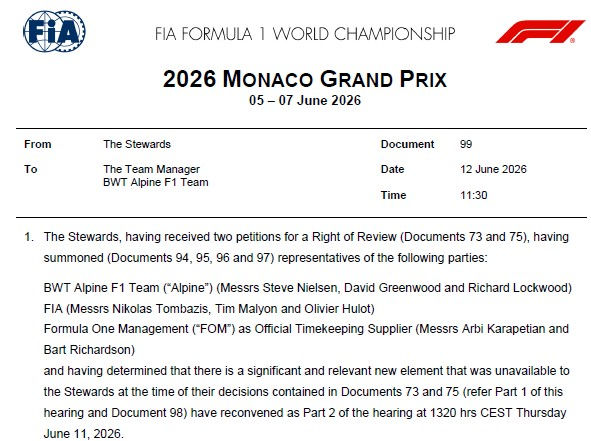
Gasly’s podium and nine lost championship points were restored. Red Bull’s Isack Hadjar lost the inherited third place, and Alpine gained nine additional constructors’ points.

For other drivers, the damage is permanent. Russell, Piastri, and others served their penalties in‑race under the same flawed configuration, materially altering their strategies and results. Still, there is no regulatory mechanism to “undo” a served penalty or re‑run a race.
This is a Data‑Governance Failure, Not a Racing Story
Viewed through a data‑risk lens, Monaco exposes failures at several layers.
1. Over‑reliance on a single authoritative system
The stewards initially relied on the official timing system and were reassured mid‑race that there was “no issue” when they queried the unusual cluster of 60.1 km/h reports in the first pit‑lane zone. The procedures, the hardware, and the survey data were treated as implicitly trustworthy.
Only after Alpine escalated with external measurements and FOM’s own post‑event scans did it become clear that the configured distance no longer reflected the revised pit‑lane geometry. In any regulated industry, this would be classified as control failure due to unverified configuration drift.
2. Weak anomaly‑detection around critical metrics
From a data‑science standpoint, the distribution of penalties was itself an anomaly signal:
Six speeding events, all in one timing zone.
Multiple infractions clustered at exactly 60.1 km/h, just 0.1 km/h above the limit.
A basic statistical monitor that tracked pit‑lane violations per zone, per weekend, against historical norms would have flagged this as a systemic issue rather than six independent micro‑errors by highly trained drivers.
3. Slow incident response and limited remediation options
Because the pit‑lane configuration error was detected only after the race, the only sanction that could be re‑examined was Gasly’s, as his penalties were still “pending” in the classification at the time of Alpine’s Right of Review.
By the time the error was formally acknowledged, other drivers had already served their penalties, and the FIA correctly noted that there is no practical, regulation‑compliant way to re‑run alternative race scenarios. That is the data‑governance equivalent of discovering a systemic error in a production system after you have already paid out on the wrong results.
For a C‑suite audience, Monaco is therefore not just a Formula 1 edge case; it is an illustration of what happens when critical infrastructure is treated as infallible, anomaly detection is shallow, and independent validation is optional rather than mandatory.
The Downstream Cascade: Barcelona and Beyond

The Monaco measurement error did not end at Monaco. Pierre Gasly’s nine reinstated points and the points lost permanently by Russell, Piastri, and others created a revised championship table that every team carried into the following weekend’s 2026 Barcelona-Catalunya Grand Prix. For McLaren in particular, Piastri’s in-race penalty — served under the same flawed loop configuration but not subject to the same Right of Review window — means those points are gone permanently, regardless of what happened in the days that followed.
This is the compounding nature of data-governance failures in high-stakes environments: the error is local, but the consequences are systemic and longitudinal. A measurement misconfiguration at one circuit reshapes competitive decisions, resource allocation, and strategic risk tolerance at every subsequent round. In any other regulated industry — financial services, aviation, nuclear — that kind of cascading exposure from a single configuration error would trigger a formal root-cause review, a corrective-action program, and an independent audit of adjacent systems. In F1, it triggered a Right of Review for one driver, left the others without remedy, and moved on.
Lessons For Telemetry and Timing Systems
The Monaco incident maps cleanly onto best practices that cybersecurity, data‑engineering, and safety leaders already recognize in other domains.
1. Treat measurement as an asset with its own threat model
In F1, timing loops, survey data, configuration files, and telemetry pipelines should be classified as critical assets, with explicit threat models that account for configuration errors, sensor drift, software changes, and attack surfaces.
This is standard practice in sectors such as financial trading and aviation, where mis‑measurement can move markets or compromise safety. The same standard needs to apply to motorsport timing.
2. Separate “system of record” from “system of validation”
The FIA/FOM timing stack is the system of record. Monaco demonstrated that teams also need a system of validation: an independent view of the same physical reality, using different data and models, designed explicitly to challenge the primary system when something looks wrong.
Without that second view, Alpine would have had only intuition, not evidence. With it, they had a credible case that reversed a podium decision.
3. Automate pattern‑level anomaly detection
Executives are often shown dashboards of single metrics; what mattered in Monaco was a pattern:
Zone‑specific clustering of infractions.
Consistently marginal over‑speeds.
Divergence between on‑car telemetry and official averages.
Those patterns are discoverable with straightforward statistical monitoring and alerting. The missing element was not data volume; it was automation of the right questions.
What An Apex‑Style Platform Would Change
Project Apex is designed as a telemetry validation and mission‑control layer that sits alongside, not inside, the existing timing and telemetry stack. If a system like Apex had been in place at Monaco for a team such as McLaren, three capabilities would have mattered.
1. Geometry‑Aware Cross‑Checks of Official Timing
Apex would continuously ingest:
Official timing data (loop crossings and reported average speeds).
High‑resolution track geometry and pit‑lane layouts.
On‑car telemetry (wheel speed, GPS, IMU, limiter status).
From these, it can recompute independent estimates of loop‑to‑loop distances and speeds, and compare them to the official values in real time. A 77‑centimetre discrepancy in the effective distance used for speed calculations would surface as a persistent delta between “what the physics says” and “what the system reports.”
That is exactly the gap that remained invisible in Monaco until the post‑event LIDAR study.
2. Structured anomaly detection on penalty patterns
Apex can maintain baselines for pit‑lane speeding incidence by zone, circuit, and year, and monitor deviations during sessions.
In Monaco, the first timing zone would have shown:
All speeding reports concentrated in a single segment.
Over‑speeds consistently within a few tenths of a kilometer per hour.
Those would exceed pre‑defined thresholds for “configuration anomaly” rather than “driver behavior,” triggering alerts to sporting and strategy staff before the race, or at least before a second wave of penalties was served.
3. Evidence‑ready Right‑of‑Review Packages
When anomalies cross certain thresholds, Apex can automatically prepare evidence bundles aligned with regulatory processes:
Time‑stamped comparisons between official and telemetry‑derived speeds.
Visualizations of penalty clustering by zone.
Quantification of how configuration changes (e.g., a 77 cm distance correction) affect calculated speeds for each car.
Instead of assembling such material manually under time pressure, teams would have a pre‑formatted dossier ready to support questions to race control or a future Right of Review.
For McLaren, which both suffered consequences at Monaco and subsequently joined Red Bull in signaling its intent to appeal the outcome, this kind of tooling would convert institutional experience into a reproducible control.
Why This Matters To C‑Suite Leaders In Motorsport and Beyond

From a leadership perspective, Monaco is not only about lost points; it is about trust in systems and governance.
Competitive risk: A single configuration error altered podium positions, constructors’ points, and prize-money trajectories at Monaco — and those consequences carried forward into Barcelona and beyond. Similar failures in other measurement domains — energy usage, safety-car deltas, track limits — can decide championships across an entire season, not just a single race.
Reputational risk: Public reversals of race results based on measurement errors undermine trust in the sport’s fairness, in the same way that financial restatements erode investor confidence.
Regulatory and legal risk: When sanctions are imposed on the basis of flawed data and cannot be undone for all affected parties, the governance model begins to appear misaligned with the basic principles of proportionality and due process.
Executives in cybersecurity and data science have seen this film before in other industries: critical systems built for a previous era of complexity are pushed to their limits without a corresponding investment in independent validation, anomaly detection, and incident‑response capability.
Project Apex is, at its core, an attempt to bring those modern controls into a motorsport context — not by replacing existing timing or telemetry systems, but by giving teams a structured, physics‑aware way to verify, challenge, and defend the data that now decides results.
This article was originally published on LinkedIn on June 17, 2026.
Timothy D. Harmon, CISSP, is a Lead Enterprise Architect, motorsport official, and the author of Project Apex, a 2026-focused cyber-physical telemetry validation concept for Formula 1. He presented “Hacking Physics at 300 KPH” at BSides San Diego 2026 and writes at The Secure Accelerator.
References
ESPN. (2026, June 11). Pierre Gasly reawarded Monaco GP podium, Alpine succeed with appeal. ESPN. https://www.espn.com/f1/story/_/id/49039206/pierre-gasly-reawarded-f1-monaco-gp-podium-alpine-succeed-appeal
Fédération Internationale de l’Automobile. (2026, June 11). 2026 Monaco Grand Prix — Decision — Car 10 (Document 99). FIA. https://www.fia.com/system/files/documents/doc_99_-_2026_monaco_grand_prix_-_decision_-_car_10.pdf
Fédération Internationale de l’Automobile. (2026, June 11). 2026 Monaco Grand Prix — Revised final race classification (Document 100) [PDF]. FIA. https://www.fia.com/system/files/documents/doc_100_-_2026_monaco_grand_prix_-_revised_final_race_classification.pdf
Karpov, O. (2026, June 12). Alpine thanks FIA and FOM for transparency as Gasly gets Monaco GP podium back. Autosport. https://www.autosport.com/f1/news/alpine-thanks-fia-and-fom-for-transparency-as-gasly-gets-monaco-podium-back/10829464/
Lamonato, M. (2026, June 12). Gasly’s Monaco third place reinstated on appeal. Racer. https://racer.com/2026/06/12/gasly-s-monaco-third-place-reinstated-on-appeal
McLaren Racing. (2026, June 4). McLaren legends unite to celebrate our 1000th GP [Photograph]. McLaren Racing. https://www.mclaren.com/racing/formula-1/2026/monaco-grand-prix/mclaren-legends-unite-to-celebrate-our-1000th-gp/
McLaren. (2026, June 14). 2026 Barcelona-Catalunya Grand Prix — Race report. McLaren Racing. https://www.mclaren.com/racing/formula-1/2026/barcelona-catalunya-grand-prix/race-report/
Mitchell‑Malm, S. (2026, June 11). F1’s stunning Gasly penalty U‑turn — all you need to know. The Race. https://www.the-race.com/formula-1/the-missing-centimetres-that-forced-f1s-stunning-gasly-penalty-u-turn/
Morales, C. (2026, June 12). Pierre Gasly regains Monaco GP podium after time penalties overturned. The Athletic. https://www.nytimes.com/athletic/7353869/2026/06/12/pierre-gasly-monaco-gp-podium-speeding/
Motorsport.com. (2026, June 11). Pierre Gasly’s Monaco GP penalty rescinded: FIA stewards report in full. Motorsport.com. https://www.motorsport.com/f1/news/pierre-gaslys-monaco-gp-penalty-rescinded-fia-stewards-report-in-full/10829447/
Noble, J. (2026, June 11). FIA stewards overturn Pierre Gasly’s penalties, restore Monaco GP podium. Motorsport.com. https://www.motorsport.com/f1/news/fia-overturns-gasly-penalties-restores-monaco-podium/10829434/


Comments