


When Data Goes to Court: How the Gasly Appeal Exposes F1’s Governance Gap — and Why Teams Need Independent Telemetry Validation

By Timothy D. Harmon, CISSPLead Enterprise Architect | Cyber-Physical Telemetry (Formula 1) | Credentialed MSUK & SCCA Official | Cisco Insider Champion

“This is not a legal story. It is a governance story — and the courtroom is where it ended up because engineering didn’t catch it in time.”
This article is a companion to “Monaco’s 77-Centimetre Error: Why Formula 1 Now Needs Independent Telemetry Validation.” That piece examined the technical failure. This one examines what happens when a data failure reaches the highest court in motorsport — and what it reveals about the governance model that let it get there.
Executive Summary
McLaren and Red Bull have escalated the fallout from Monaco’s pit-lane timing error to the FIA’s International Court of Appeal (ICA) in Geneva — Formula 1’s final judicial body.
Their core argument is that rescinding Pierre Gasly’s penalties after the fact created sporting inequity. Drivers who served their penalties in good faith were left with no remedy, while Gasly’s podium was restored.
The ICA can confirm, alter, or waive penalties. It cannot replay races, reverse in-race strategy calls, or make all affected parties whole.
This case is now a governance and incentives problem, not just a timing one. Without an independent validation layer during the event, the sport’s only recourse is expensive, slow, post-race litigation.
Project Apex — a parallel telemetry validation and audit layer — is designed to reduce the probability that timing and data failures ever require a courtroom to resolve.
What Changed Since Monaco: From Timing Loop to Courtroom
At the 2026 Monaco Grand Prix, a misconfigured distance in the first pit-lane timing segment caused average speeds to be over-reported. Multiple drivers received marginal speeding penalties — many at exactly 60.1 km/h in a 60 km/h zone.
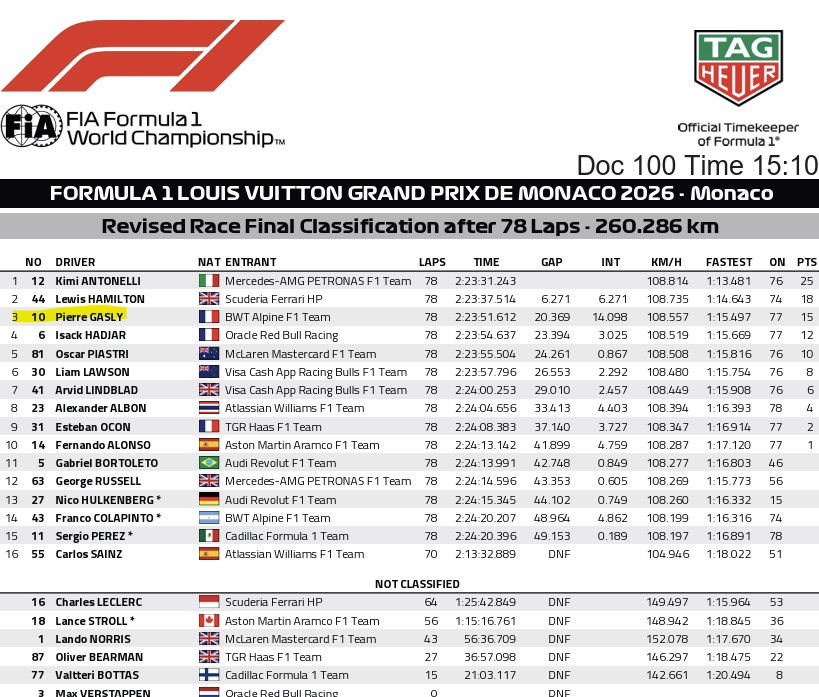
Alpine, armed with new evidence from the official timekeeper, successfully argued through the Right of Review process that Pierre Gasly had never actually exceeded the limit. The stewards agreed and restored his podium. But the fix was partial:
Gasly’s third place was reinstated. Alpine gained nine constructors’ points.
Piastri, Russell, and others had no recourse. They had already served their penalties in-race under the same flawed configuration, permanently altering race strategy and final positions.
McLaren and Red Bull confirmed their appeals to the ICA, contesting the revised classification on grounds of sporting fairness, regulatory consistency, and the integrity of competition.
“The subsequent removal of penalties creates a situation in which some competitors are disadvantaged by having acted in accordance with the rules and the stewards’ decisions. Such an outcome risks creating sporting inequity.” — McLaren Racing, official appeal statement
Meanwhile, Mercedes explored a Right of Review for George Russell and withdrew — acknowledging that unwinding a penalty already served inside the regulatory framework was effectively impossible.
From Timing Error to Governance Problem
The root cause is technical; the consequences are institutional. Three governance failures compound each other.
1. Asymmetric Remedies Create Perverse Incentives
Gasly could be made whole because his penalty existed only on paper at the flag. The regulatory framework had a lever to pull.
Drivers who serve penalties in-race have no equivalent lever. The race — its strategy, pace, and positions — is irrevocably over. This asymmetry quietly teaches a dangerous lesson:
If the data might be wrong, it is safer not to serve the penalty in-race. You can always litigate later.
That is not a hypothetical concern. McLaren’s appeal statement says precisely this: the precedent risks incentivizing competitors not to comply with penalties promptly — a direct threat to the sport’s operating model.
2. Litigation as a Substitute for Validation
The fact that Alpine, McLaren, Red Bull, and Mercedes have all engaged lawyers over a timing configuration error is an indictment of the in-event control stack.
In aviation, financial trading, and nuclear operations, when critical measurement data is in doubt, the first reflex is:
Validate through an independent channel.
Ring-fence downstream decisions until the anomaly is resolved.
Preserve a tamper-evident audit trail.
In Monaco 2026, the reflex chain was different: trust the system, issue penalties, reassure stewards mid-race that there is “no issue,” and reconstruct events days later in a legal process — after the race and its strategies are irrevocably over.
In this case, the ICA has become a last-line validator for data that should have been cross-checked while the cars were still running.
3. A Precedent That Reshapes Competitive Behavior
Teams are rightly worried. The Monaco precedent now means that every ambiguous penalty call carries the shadow of a potential Right of Review and ICA appeal. That pressure reshapes:
How aggressively teams push for immediate penalty compliance.
How confident strategists are in acting on official systems when anomalies are suspected.
How frequently they feel compelled to reserve legal options rather than focusing on racing.
“The subsequent removal of penalties creates sporting inequity and undermines confidence in the consistent application of the FIA Sporting Regulations.” — McLaren Racing
What the ICA Can — and Cannot — Fix
The International Court of Appeal is the final, independent appeal tribunal for international motorsport. It is composed of 36 judges elected at the FIA General Assembly and sits in Geneva. For this case, at least three judges will be assigned; the court president, Lauren Anselmi of Monaco, will preside.
The ICA can:
Confirm the stewards’ decision to rescind Gasly’s penalties.
Alter the decision — for example, reinstating some or all of the original sanctions.
Waive penalties or recommend regulatory reform.
The ICA cannot:
Re-run Monaco’s race or re-simulate strategies.
Redistribute every point affected by the systemic timing error.
Restore what was lost by drivers who served penalties in good faith before the error was discovered.
Whatever the Geneva judges decide, the deeper governance question will remain:
How do we ensure that a 77-centimetre timing misconfiguration never again requires a courtroom to resolve?
What an Independent Telemetry Validator Would Change
“Apex is not a replacement for FIA/FOM timing. It is an independent second opinion — designed to catch the anomalies the primary system cannot see in itself.”

Project Apex is a cyber-physical telemetry validation layer that runs alongside — not inside — the official timing and telemetry stack. In Monaco’s context, three capabilities matter most.
1. Real-Time Pattern Detection on Penalty Events
Apex continuously cross-checks:
Official timing data (loop crossings and reported average speeds)
On-car telemetry (wheel speed, GPS, pit-lane limiter status)
Track and pit-lane geometry for the active configuration
From this, it can identify patterns like “all speeding reports are concentrated in one zone” and “multiple drivers are at +0.1 km/h over the limit with limiter engaged” — patterns that strongly indicate a configuration issue, not six simultaneous driver lapses.
Those flags would surface during the race, before a second or third wave of penalties compounds the damage — and before the data has been acted on in ways that cannot be undone.
2. Evidence-Grade Audit Trails for Right of Review and ICA
When anomalies exceed defined thresholds, Apex automatically preserves structured case files aligned with FIA judicial processes:
Timestamped comparisons between official speeds and telemetry-derived speeds, per car, per lap
Statistical distributions of penalties by zone and severity
Geometry overlays showing how track configuration changes alter effective distances between timing loops
Cryptographically hashed log exports, preserving integrity for submission to stewards or the ICA
Instead of Alpine’s team manually assembling this material under time pressure days after the race, a validator produces it as a matter of course — and makes it available to all affected teams, not just those with resources for a bespoke Right of Review.

3. Governance Analytics Across the Season
Over a full season, Apex’s view becomes a governance dataset:
How often do timing anomalies occur by circuit and configuration type?
Which error classes — survey drift, config update failures, hardware degradation — recur?
How quickly are anomalies detected and escalated versus left to compound?
Those metrics feed internal risk dashboards for team leadership and provide a concrete, evidence-based foundation for regulatory dialogue with the FIA and FOM — grounded in numbers rather than post-event anecdote.
What This Means for Teams Like McLaren
For McLaren, this appeal is not about one podium. It is about three converging risks.

A team deploying an independent validator can credibly say to stakeholders, sponsors, and fans:
“We are not only building fast cars. We are investing in governance, transparency, and fairness — using the same telemetry that wins races to protect the integrity of competition.”

Where Formula 1 Goes from Here
The ICA will convene in Geneva, likely in July. Its judges will interpret the Sporting Regulations, weigh the evidence, and reach a verdict. The case will be resolved — on paper.
But the governance gap will remain until the sport decides that independent validation is infrastructure, not optional enhancement. The Monaco precedent has already changed behavior in paddocks, strategy rooms, and legal departments. The only question is whether it also changes the engineering and governance stack.
“In a championship decided by milliseconds, the governance of measurement is as important as the engineering of speed.”
Project Apex is one proposal for how teams can begin to embody that principle today — catching anomalies before they become penalties, preserving evidence before it is needed, and making it less likely that the next data failure ends up in a Geneva courtroom.
Timothy D. Harmon, CISSP, is a Lead Enterprise Architect, motorsport official, and the author of Project Apex, a 2026-focused cyber-physical telemetry validation concept for Formula 1. He presented “Hacking Physics at 300 KPH” at BSides San Diego 2026 and writes at The Secure Accelerator.
References
Cleeren, F. (2026, June 22). What happens next as appeal against Gasly’s Monaco podium decision goes to court. Autosport. https://www.autosport.com/f1/news/what-happens-next-as-appeal-against-pierre-gaslys-f1-monaco-decision-goes-to-court/
ESPN. (2026, June 11). Pierre Gasly reawarded Monaco GP podium, Alpine succeed with appeal. ESPN. https://www.espn.com/f1/story/_/id/49039206/
Fédération Internationale de l’Automobile. (2026, June 11). 2026 Monaco Grand Prix — Decision — Car 10 (Document 99). FIA.
Formula 1. (2026, June 15). McLaren lodge notification of appeal against Gasly’s reinstated Monaco podium. Formula1.com.
ESPN. (2026, June 16). Red Bull join McLaren in appealing Pierre Gasly’s reinstated podium. ESPN.
The Telegraph. (2026, June 12). Mercedes consider legal action over F1’s Monaco penalties farce. The Telegraph.
FIA. (n.d.). International Court of Appeal. https://www.fia.com/fia-courts
Motorsport.com. (2026, June 21). Monaco F1 controversy goes to court: What happens next for Pierre Gasly? Motorsport.com.
Comments